Blog
What Is a Spa Chiller and How Does It Work?
A Spa Chiller keeps hot-tub water comfortable by removing unwanted heat. Unlike a heater, it transfers heat away from the water. The process begins when a circulation pump moves warm water through a heat exchanger. Inside that exchanger, refrigerant absorbs the water’s heat. The cooled water then returns to the spa, while the refrigerant carries the captured heat toward the condenser.
John Barba, a respected hydronic-systems educator, explains the principle in practical terms: “A chiller removes heat from water, then sends that cooled water back into the system.” The equipment uses several coordinated parts, including a compressor, condenser, expansion valve, evaporator, sensors, and control board. Each part affects performance. A blocked filter can reduce flow. Poor ventilation can raise operating temperatures. Incorrect sizing can create short cycling, noise, or disappointing cooling.
The idea sounds simple. It is not always simple in practice. A reliable Spa Chiller must match the spa’s water volume, desired temperature, climate, insulation, and daily usage. Outdoor spas may gain heat from direct sunlight, warm air, pumps, and nearby equipment. These details can change the cooling load more than expected. Regular cleaning and professional inspection also matter, especially around electrical connections and refrigerant components.
This guide will explain how a Spa Chiller works, what happens inside its refrigeration loop, and how each component supports cooling. It will also examine efficiency, installation conditions, maintenance needs, and common sizing mistakes. Some manufacturers emphasize maximum cooling capacity. Real-world performance deserves equal attention. A powerful unit is not automatically the best choice.
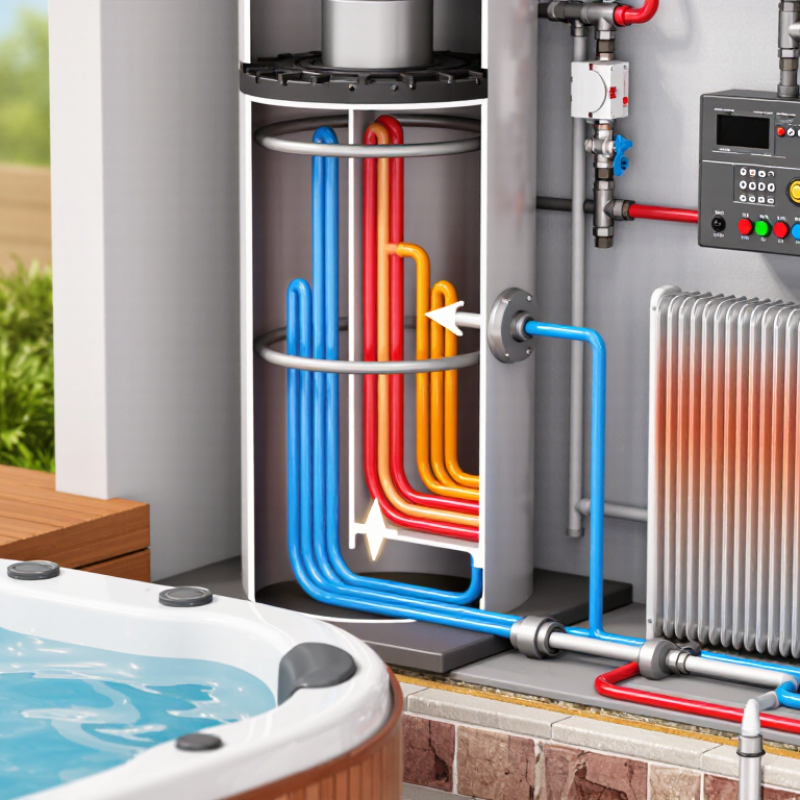
Table of Contents [Hide]
What Is a Spa Chiller?
What Is a Spa Chiller?
A spa chiller is a refrigeration system that removes heat from circulating spa water. It is not simply a stronger filter. A pump sends warm water through the chiller’s evaporator, where refrigerant absorbs heat. The compressor raises refrigerant pressure, and the condenser releases heat into surrounding air or water. An expansion device then lowers pressure, repeating the cycle.
Many units maintain water between approximately 5°C and 18°C, depending on the spa’s purpose, insulation, and control settings. The U.S. Department of Energy explains that refrigeration equipment performs better when airflow, heat transfer, and maintenance remain stable. This matters in real installations. A blocked condenser can make a chiller run longer while cooling less effectively. That detail is easy to miss.
Performance should be judged carefully. AHRI Standard 550/590 provides standardized methods for rating water-chilling equipment, but actual spa conditions can differ substantially. Ambient temperature, bathers, cover quality, and water flow all affect capacity. The International Energy Agency reported that buildings consumed about 30% of global final energy in 2022, making efficient operation more than a technical preference. A smaller chiller may save electricity, yet it can struggle after heavy use. Bigger is not always better. Insulation, accurate sensors, and regular cleaning often deserve equal attention.
What Is a Spa Chiller and How Does It Work?
| Data Dimension | Typical Information | How It Relates to Spa Cooling |
|---|---|---|
| Primary Purpose | Removes heat from spa or swim-spa water. | It helps lower water temperature when ambient heat, sunlight, pumps, or frequent use make the water too warm. |
| Basic Operating Principle | A refrigeration circuit transfers heat from the water to the surrounding air. | Water passes through a heat exchanger, while a refrigerant cycle absorbs and rejects heat through separate components. |
| Main Refrigeration Components | Compressor, condenser, expansion device, and evaporator or water heat exchanger. | The compressor circulates refrigerant; the heat exchanger extracts heat from the water; the condenser releases the collected heat to the air. |
| Typical Water Temperature Range | Approximately 50–85°F (10–29°C), depending on the application and control settings. | Lower settings are common for cold-water or exercise use, while higher settings may be used for recreational spa operation. |
| Cooling Capacity | Common residential and light-commercial units may provide roughly 12,000–60,000 BTU/h (3.5–17.6 kW) of cooling capacity. | The required capacity depends on water volume, target temperature, outdoor temperature, sunlight exposure, insulation, and desired pull-down time. |
| Water-Circulation Requirement | Many systems operate with approximately 10–60 gallons per minute (38–227 liters per minute), depending on unit size. | A circulation pump must provide sufficient flow without exceeding the chiller’s specified pressure or flow limits. |
| Heat-Transfer Medium | Water flows through a corrosion-resistant heat exchanger, often made from titanium, stainless steel, or another compatible material. | The exchanger separates the spa water from the refrigerant and helps protect the refrigeration circuit from moisture and treatment chemicals. |
| Control Method | Digital thermostat, temperature sensor, or integrated controller. | The controller switches cooling on or off, or adjusts operation, to maintain the selected water temperature. |
| Water Treatment Compatibility | Compatibility depends on sanitizer type, chemical concentration, pH, salinity, and the heat-exchanger material. | Correct water chemistry is necessary to reduce corrosion, scaling, and fouling inside the heat exchanger. |
| Airflow Requirement | The condenser needs unobstructed airflow to release heat. | Blocked vents, inadequate clearance, or hot enclosed spaces can reduce cooling performance and increase energy consumption. |
| Energy Use | Power consumption varies by cooling capacity, outdoor temperature, water temperature, and efficiency. Many units draw approximately 1–6 kW while operating. | Better insulation, a fitted spa cover, clean filters, and moderate temperature settings can reduce operating time and electricity use. |
| Cooling Time | Cooling time can range from several hours to more than a day. | The result depends mainly on water volume, temperature difference, cooling capacity, ambient conditions, and whether the spa is covered. |
| Filtration Function | A spa chiller cools water but does not normally replace the filtration system. | The spa still requires a filter, circulation system, and appropriate sanitation process to maintain water quality. |
| Installation Position | Usually installed outdoors or in a well-ventilated equipment area near the spa. | The location should allow service access, proper drainage, safe electrical connection, and sufficient clearance around air inlets and outlets. |
| Common Applications | Swim spas, exercise pools, hydrotherapy facilities, hot tubs, and temperature-controlled soaking systems. | It is especially useful where water must be maintained below the temperature naturally produced by the environment or heating equipment. |
| Maintenance Requirements | Periodic filter cleaning, heat-exchanger inspection, airflow cleaning, water-chemistry checks, and professional refrigeration service when required. | Routine maintenance helps preserve heat transfer, prevent chemical damage, and maintain stable cooling performance. |
Note: Actual performance, electrical requirements, flow limits, refrigerant type, and temperature range vary by equipment design and installation conditions. Always follow the applicable technical specifications and local electrical and safety requirements.