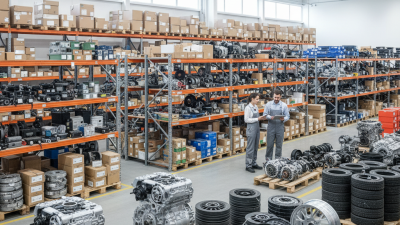
Global buyers need more than a long supplier list when sourcing automotive parts. They need evidence, consistency, and clear communication. A reliable supplier should show production capabilities, material records, inspection reports, and realistic delivery schedules. Factory photographs help, but they never replace an audit or a sample inspection.
Quality expert W. Edwards Deming said, “Quality comes not from inspection, but from the improvement of the production process.” His principle remains highly relevant to automotive parts procurement. Strong suppliers control quality before packaging begins. They monitor dimensions, surface finishes, heat treatment, and batch traceability. Buyers should also examine how suppliers manage changes, rejected parts, and corrective actions. A polished website proves very little.
Small details often expose larger risks. Check whether cartons protect connectors from moisture. Confirm whether part numbers remain readable after transport. Ask how a supplier handles a tolerance dispute across time zones. These questions may feel slow.
They prevent expensive surprises.
Global purchasing also requires balanced judgment. The lowest quote can hide weak tooling, unstable materials, or poor after-sales support. However, a higher price does not automatically guarantee better performance. Buyers should compare total cost, including testing, freight, warranty exposure, and replacement delays. No supplier is perfect, and no audit predicts every future problem. That limitation deserves honest attention. This guide introduces leading automotive parts suppliers for global buyers, while encouraging practical verification, documented communication, and decisions based on measurable evidence rather than confident promises.

OICA recorded 93,546,599 motor vehicles built worldwide in 2023. That scale turns automotive parts sourcing into a continuous, multi-tier operation. A single vehicle may require thousands of components, from stamped panels to sensors and sealing rings. Global buyers should examine production capacity, process controls, and traceability before comparing prices. A low unit cost means little if one missing connector stops an assembly line.
The International Energy Agency reported nearly 14 million electric cars sold in 2023, representing about 18% of global car sales. This shift increases demand for battery enclosures, thermal-management parts, power electronics, and high-voltage safety components. Suppliers should provide material certificates, dimensional inspection records, and lot-level identification. PPAP experience and ISO 9001-based quality systems also matter during supplier approval. Practical checks help: request a recent control plan, inspect sample packaging, and verify how rejected parts are isolated.
The figures are useful, but not perfectly clean. Production totals combine different vehicle categories and regional reporting methods. A spreadsheet can still hide weak continuity planning. Buyers should test supplier response times, alternate tooling options, and container loading procedures. A 40-foot container packed without moisture protection can turn reliable components into expensive scrap. The IEA’s transition data also suggests another risk: demand may change faster than tooling investments. Experienced sourcing teams leave room for specification updates, pilot batches, and honest correction when the original forecast proves wrong.
Automotive parts suppliers operate in different tiers, and each tier serves a distinct purchasing need. OEM suppliers produce parts to the vehicle maker’s original specifications. They usually follow strict engineering controls, documented testing, and formal change-management procedures. Their production records often support traceability from raw material to finished component. OEM sourcing can offer strong consistency, but it may involve higher minimum order quantities and longer approval cycles.
Tier 1 suppliers deliver complete systems, such as braking modules, instrument panels, or powertrain assemblies. They often manage design validation, testing, and coordination with several lower-tier partners. Tier 2 suppliers typically manufacture specialized components, including castings, sensors, fasteners, or molded parts. Their technical depth can be excellent, especially for a narrow process. However, buyers should verify capacity, quality records, inspection equipment, and backup production plans. Small gaps matter. Aftermarket suppliers serve replacement demand outside the original vehicle production channel. They may offer broader availability, flexible packaging, and competitive pricing. Quality can vary more widely, so buyers should review material certificates, dimensional reports, warranty terms, and sampling procedures. A supplier’s label does not guarantee performance. One practical mistake is treating tier status as a quality ranking. It is not. A careful buyer compares documentation, process control, communication speed, and delivery reliability before approving a source. Some suppliers may appear efficient until an unexpected tooling change exposes weak controls. That possibility deserves honest attention.
Supplier tiers differ by their position in the vehicle value chain. This industry-typical role intensity index compares design ownership, system integration, component specialization, and replacement support across OEM, Tier 1, Tier 2, and aftermarket suppliers.
Scores use a 0–100 role-intensity scale and describe common industry responsibilities rather than company performance or market share.
Global buyers often begin supplier research with one practical question: can this company deliver consistently across markets? In 2023, one leading automotive parts supplier reported €90.3 billion in sales. That figure signals exceptional operating scale, broad customer reach, and substantial production capacity. It does not automatically prove suitability for every buyer. Scale matters, but it can mislead.
Experienced procurement teams examine the details behind revenue. They review audited financial reports, plant locations, production technologies, and quality certifications. They also test response times before signing large contracts. A reliable supplier should provide traceability from raw material intake to final inspection. For a steering component, buyers may request batch records, dimensional reports, and sample parts measured with calibrated equipment. Small evidence often reveals large weaknesses.
Global sourcing also requires practical checks. Can the supplier support left-hand and right-hand drive variants? Can it maintain packaging standards during a six-week sea journey? Are replacement parts available after production changes? These questions expose gaps that a sales presentation may hide. Many procurement plans focus heavily on unit price while overlooking tooling ownership and warranty handling. That approach looks efficient at first. It may become expensive later. The €90.3 billion benchmark is impressive, yet buyers should compare regional service, technical support, lead times, and verified performance before choosing a partner.
Global EV sourcing is expanding, but the numbers require careful reading. The International Energy Agency’s Global EV Outlook 2024 recorded nearly 14 million electric car sales in 2023. Some market estimates approach 18 million when broader plug-in categories and reporting methods are included. Buyers should verify definitions before setting volume targets.
Battery cells, power electronics, thermal systems, and charging components remain key purchasing categories. The IEA reported that electric cars represented about 18% of global new-car sales in 2023. This shift increases demand for high-voltage connectors, battery enclosures, inverters, and cooling plates. Suppliers with traceable materials and consistent testing are easier to qualify.
Quality evidence matters.
The International Energy Agency also noted that battery pack prices fell sharply in 2023, improving cost pressure across the supply chain. However, cheaper components can create inspection risks. Global buyers should request batch records, electrical safety test results, dimensional reports, and sample validation before signing long-term contracts. The U.S. Department of Energy highlights battery safety, thermal control, and manufacturing consistency as critical performance areas. In practice, I have found that delivery promises often look stronger than factory capacity. A supplier audit, small pilot order, and independent inspection may prevent expensive surprises. The market is growing quickly, but sourcing decisions still need patience.
Top Automotive Parts Suppliers for Global Buyers
Global buyers should judge automotive parts suppliers beyond unit price. Quality begins with controlled materials, stable tooling, and documented inspections. Ask for dimensional reports, batch traceability, and failure-analysis records. A supplier that explains defects clearly is often more reliable than one promising perfection. Real factories have occasional deviations.
Compliance must cover the destination market and the vehicle application. Verify material declarations, product testing, export documents, and quality certifications. Check whether records remain accessible after shipment. Lead time also needs evidence. Request a production schedule, sampling timeline, packaging plan, and realistic shipping window. A short promise means little without capacity data.
Tips: Compare total cost, not just quotation price. Include tooling, inspection, packaging, freight, duties, inventory, warranty claims, and possible line stoppages. Ask suppliers to model two order volumes. Review their assumptions carefully. A cheaper part may require more inspection or create costly delays. Keep a small safety stock when transport routes are uncertain, but avoid excessive inventory. Suppliers should report changes in materials, processes, or subcontractors before production. That discipline supports trust, even when communication is not perfect.
Practical global sourcing benchmarks for evaluating automotive component suppliers. Values are indicative procurement targets and should be validated by product type, destination market, Incoterms, order volume, and applicable regulations.
| Evaluation Dimension | Recommended Buyer Metric | Practical Benchmark or Target | Verification Evidence | Suggested Weight |
|---|---|---|---|---|
| Quality Management System | Certification and process control maturity | IATF 16949 for automotive production; ISO 9001 where IATF 16949 is not contractually required | Valid certificate, certification scope, audit report, corrective-action records, and certificate database confirmation | 15% |
| Defect Performance | Customer PPM, warranty returns, and corrective-action closure | Use a product-specific target; a mature supplier scorecard may set 50–100 PPM for stable, high-volume parts and track zero critical defects | 12-month PPM trend, warranty data, 8D reports, control plan, PFMEA, and process capability studies | 20% |
| Product Validation | Design verification and production-part approval | Complete PPAP or equivalent approval package before serial production, including dimensional, material, performance, and capability evidence | Approved drawings, PPAP level, material certificates, test reports, sample approval, and change-control procedure | 10% |
| Regulatory Compliance | Market-specific legal and material compliance | Compliance must match the destination market, including applicable requirements such as REACH, RoHS, ELV, conflict-minerals reporting, and chemical declarations | Declaration of conformity, laboratory reports, full material disclosure, restricted-substance records, and traceability documents | 15% |
| Production Lead Time | Time from approved order to ex-works readiness | Stocked parts: approximately 1–3 weeks; standard made-to-order parts: approximately 4–8 weeks; new tooling or validation may add 8–16 weeks | Capacity plan, confirmed production schedule, historical on-time delivery, bottleneck analysis, and escalation process | 10% |
| International Transit | Transport time, customs risk, and delivery reliability | Ocean freight commonly requires about 25–45 days port-to-port; air freight commonly requires about 3–7 days airport-to-airport, excluding customs and inland delivery | Lane-specific freight quotation, sailing or flight schedule, customs documents, cargo insurance, and contingency route | 5% |
| Minimum Order Quantity | Fit between supplier batch economics and buyer demand | Compare MOQ with annual demand, forecast accuracy, shelf life, packaging quantity, and inventory carrying cost | Written MOQ, price breaks, packaging specification, order flexibility, and forecast or blanket-order terms | 5% |
| Total Landed Cost | Cost beyond the quoted unit price | Calculate unit price plus tooling amortization, packaging, freight, duties, insurance, inspection, warehousing, financing, quality losses, and warranty exposure | Comparable Incoterms quotation, duty classification, freight quote, tooling ownership terms, payment terms, and cost-of-quality records | 15% |
| Payment and Commercial Risk | Cash-flow exposure and financial resilience | Prefer staged payments tied to verifiable milestones; assess currency, tooling prepayment, credit terms, and continuity risk | Audited financial information where available, bank references, contract terms, insurance, and business-continuity plan | 5% |
Buyer Decision Rule
Select the supplier with the strongest risk-adjusted total value rather than the lowest quoted unit price. Require documented compliance, validated samples, clear change notification, traceability, and a realistic logistics plan before awarding serial-production business.
Note: Lead times, PPM targets, freight durations, duties, and compliance obligations vary by component, origin, destination, order volume, transport lane, and regulatory jurisdiction. Confirm all values during RFQ and supplier qualification.
Logel’s Auto Parts
116 Bridge St East
Kitchener, Ontario
N2K 1J6
Phone: 519-745-4751
Toll Free: 1-800-818-9118
Hours 8:00-5:00 Monday to Friday
At Logel’s Auto Parts, we serve a range of communities in Southern Ontario, including:
Sign up today for the latest updates from the Logel’s Auto Parts team, including pricing for scrap vehicles, our newest product lines, current operating hours, and much more.