Blog
How to Choose the Best Rubber Base Kart Track Barrier?
Choosing the best Rubber‑Base Kart Track Barrier requires more than comparing thickness, color, or price. The barrier must control impact energy, protect drivers, remain stable, and support quick track operations. FIA Karting Circuit Regulations emphasize clear run-off areas, secure barrier placement, and consistent protection near high-risk zones. These requirements provide a useful professional baseline, although they do not approve every commercial product.
The 2024 FIA Karting safety guidance should be read alongside manufacturer test data and relevant impact standards. ASTM F2656 and MASH procedures are not kart-track approvals, but they demonstrate why testing methods, vehicle mass, impact speed, and anchoring details matter. Industry market reports, including Allied Market Research’s Go-Kart Market analysis, also show growing investment in organized karting facilities. More investment means higher expectations for reliable safety equipment.
Peter Wright, former chairman of the FIA Safety Commission, expressed a principle that applies directly here: “A barrier must manage energy, not simply stop a vehicle.” That distinction matters. A hard, poorly secured block can redirect a kart toward another driver. A soft barrier can deform excessively and expose gaps. Neither choice is automatically safe. The right Rubber‑Base Kart Track Barrier should match corner speed, kart weight, surface conditions, climate, and maintenance capacity. Look for documented compression behavior, UV resistance, modular connectors, drainage, and replaceable sections. I would also inspect one installed barrier after repeated impacts. Product brochures rarely show the whole story.
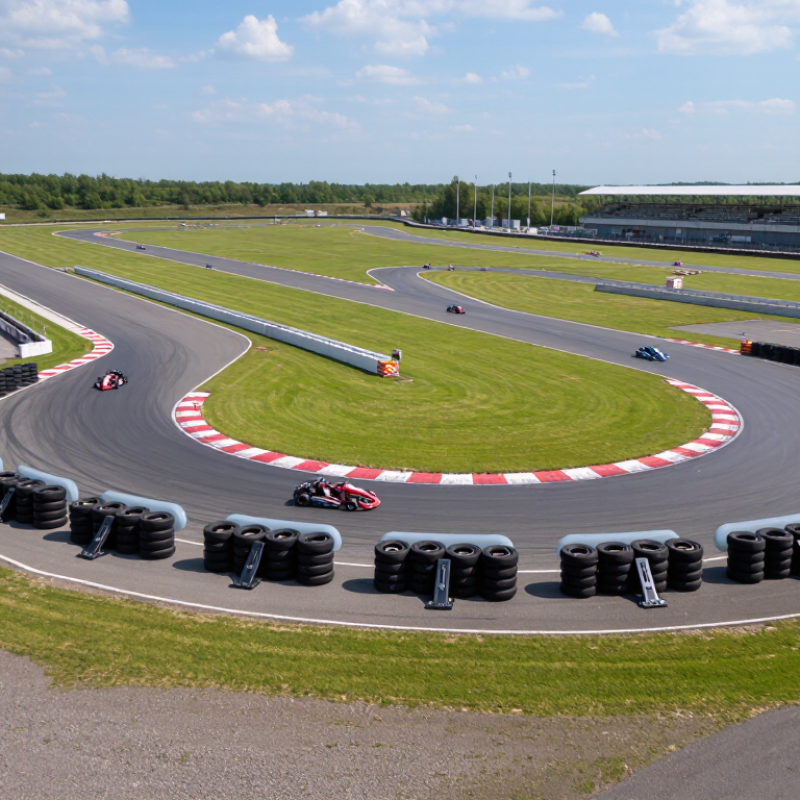
Table of Contents [Hide]
Define Impact Zones with CIK-FIA Layout Rules and Track-Speed Data
Choosing a rubber base kart track barrier starts with impact mapping, not color or price. CIK-FIA layout guidance helps define protected areas, escape routes, and barrier continuity. However, every circuit needs a site-specific review. Track width, runoff space, corner radius, and surface grip change the risk.
Collect speed data from timing loops, GPS logs, and corner video. Record entry speed, braking point, racing line, and impact angle. A fast, blind corner deserves more protection than a slow hairpin. Place barriers outside the likely exit path, not directly beside the apex without clearance. Keep transitions smooth and avoid exposed gaps between units. The rubber base should resist movement while allowing controlled energy absorption. Check its stability after several sessions.
I once underestimated a short downhill bend. The average speed looked moderate, yet drivers arrived faster than expected. The first barrier position was too close. It needed more space and a longer protective line. That mistake still matters. Use current CIK-FIA requirements, local authority rules, and the manufacturer’s installation data before opening the track. Inspect connectors, base alignment, and surface wear daily. A barrier can look secure while shifting under repeated impacts. Review speed data after wet sessions too. Grip changes everything. Safety planning is never perfectly finished.
How to Choose the Best Rubber Base Kart Track Barrier? - Define Impact Zones with CIK-FIA Layout Rules and Track-Speed Data
Planning matrix for selecting barrier coverage, placement and inspection priorities by track-speed exposure. Values are engineering-planning references and must be verified against the current circuit homologation requirements and site-specific risk assessment.
| Impact Zone | Typical Track Section | Representative Speed | Planning Speed | Assumed Combined Mass | Approx. Kinetic Energy | Barrier Layout Priority | Rubber-Base Barrier Selection Guidance |
|---|---|---|---|---|---|---|---|
| Zone A: Low-Speed Corner | Hairpin, tight chicane or pit-entry approach | 25–40 km/h | 40 km/h | 180 kg | 11.1 kJ | Basic protection Cover exposed walls, posts and track furniture. | Use stable, interlocking rubber modules with a continuous face. Keep the barrier aligned with the expected vehicle path and remove gaps that could catch a kart. |
| Zone B: Medium-Speed Corner | 90-degree turn, flowing bend or exit kerb | 40–60 km/h | 60 km/h | 180 kg | 25.0 kJ | Enhanced protection Prioritize outside corners and exit trajectories. | Choose heavier rubber bases or linked modules that resist sliding and rotation. Add a secondary protective layer where the run-off is limited. |
| Zone C: High-Speed Bend | Fast sweeper, kink or long-radius corner | 60–85 km/h | 80 km/h | 180 kg | 44.4 kJ | High protection Provide a generous, unobstructed recovery area before the barrier. | Use a continuous, multi-module barrier system with high lateral stability. Avoid isolated blocks and rigid protrusions behind the impact face. |
| Zone D: Main Straight Braking Area | End of straight, heavy-braking approach or overtaking zone | 70–100 km/h | 95 km/h | 180 kg | 62.8 kJ | Very high protection Use the longest available run-off and protect the outside of the braking line. | Do not rely on a single lightweight row. Use a properly connected, high-mass rubber system and verify its position after repeated impacts and wet-weather movement. |
| Zone E: Maximum-Speed Exposure | Long straight, fast kink or downhill approach | 90–110 km/h | 110 km/h | 180 kg | 84.0 kJ | Critical protection Prefer expanded run-off, redirection and distance from fixed hazards. | Rubber barriers should be treated as part of a complete safety system, not as a substitute for adequate run-off. Obtain specialist review before placing them at an unavoidable high-energy impact point. |
| Zone F: Pit-Lane or Service Interface | Pit entry, pit exit, marshal access or pedestrian-adjacent area | 10–40 km/h | 30 km/h | 180 kg | 6.3 kJ | Controlled protection Separate vehicle paths from people and service equipment. | Select low-profile, highly visible modules that cannot create a trip hazard. Confirm that barrier placement preserves sight lines, access gates and emergency routes. |
Calculation basis: Approximate kinetic energy is calculated using the formula E = ½mv², with a planning mass of 180 kg for kart plus driver. The values describe vehicle energy before impact and do not represent the force absorbed by the barrier.
CIK-FIA-aligned layout principles: Keep hazardous fixed objects outside the foreseeable vehicle path wherever practicable; provide suitable run-off; use continuous protective arrangements at exposed hazards; avoid barrier gaps, sharp edges and unstable placement; maintain marshal, medical and emergency access; and verify the final arrangement against the current applicable karting-circuit regulations and homologation requirements.
Speed note: The speed bands are typical planning ranges for rental and sprint-kart environments, not universal limits. Actual entry speed, kart specification, gradient, surface grip, weather, driver skill and traffic conditions should be measured at the specific circuit.
Reference framework: Current FIA karting circuit regulations, FIA circuit safety principles, site-specific speed measurements, braking-distance assessment and a competent engineer’s impact-zone review.