China Top 10 Car Paint Protection Film Manufacturers

China’s car-care market is changing quickly. Buyers now expect more than a glossy showroom finish; they want protection that remains clear after daily commutes, road grit, and repeated washing. Car Paint Protection Film (PPF) helps shield vulnerable painted panels from stone chips and light abrasion, but results depend on film quality, surface preparation, and installation skill.

Industry reports offer useful context, though their market estimates differ because they define products and regions differently. Grand View Research’s paint protection film market analysis identifies rising vehicle ownership and demand for automotive surface protection as growth drivers. Fortune Business Insights also tracks automotive applications and material innovation in its market coverage. These reports signal a developing category, not a guarantee that every product performs equally. Look closely at warranty terms, film construction, clarity, yellowing resistance, and installer support.

Detailing educator Mike Phillips is known for practical guidance on vehicle care. A concise paraphrase of that detailing-first perspective is: “Long-term paint protection starts with sound preparation and careful installation.” This is a paraphrase, not a verified verbatim quotation. That distinction matters. It would be careless to treat marketing claims as independent test results.

This guide introduces ten Chinese manufacturers and the capabilities buyers should compare. Expect differences in film technology, product range, quality documentation, and export experience. A glossy sample helps, but it cannot reveal everything. Ask for technical data, sample evaluations, and clear installation guidance before choosing a supplier.
China Top 10 Car Paint Protection Film Manufacturers

What Car Paint Protection Film Is and How It Works

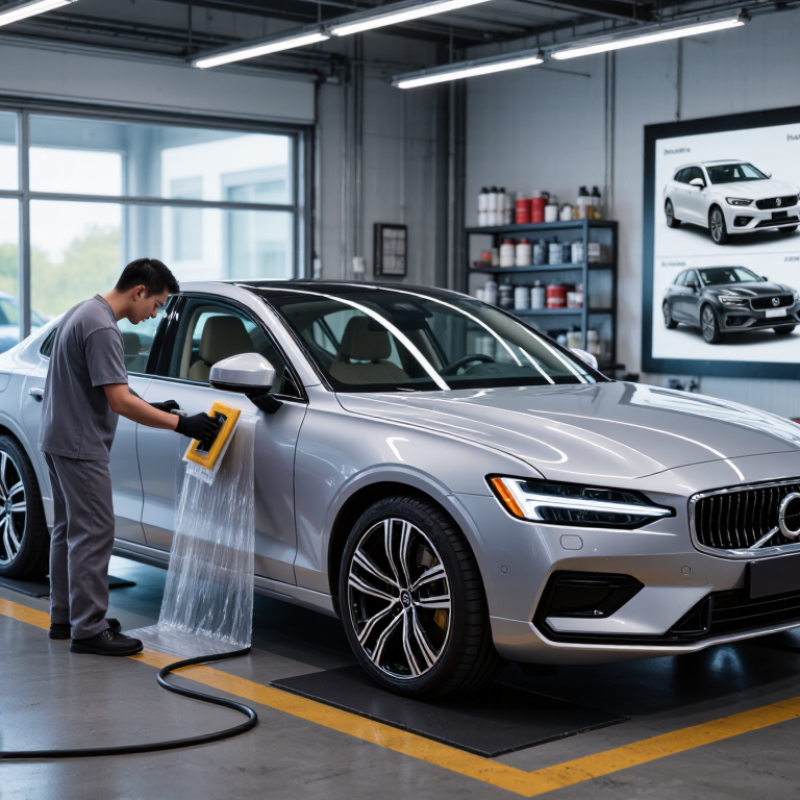
Paint protection film (PPF) is a transparent, flexible layer applied over a vehicle’s painted panels. Most products use a thermoplastic polyurethane film, a pressure-sensitive adhesive, and a protective topcoat. Think sacrificial layer. The film absorbs some impact from road grit and helps resist stains from insects, bird droppings, and road tar. It can reduce minor surface damage, but it cannot prevent every chip or scratch.

Some films have elastomeric topcoats that soften the appearance of light marks when warmed by sunlight or warm water. This effect depends on the film and the damage; deep cuts usually remain visible. Not armor. OICA’s 2023 production statistics recorded about 93.5 million motor vehicles produced worldwide. That figure shows the scale of vehicle use, not PPF adoption or proven protection rates. For an owner, coverage quality matters: clean panel edges, careful installation, and timely removal of contaminants all affect the result. Film can also change a paint surface’s gloss slightly, so expectations should stay realistic.


How Paint Protection Film Is Made and Evaluated

China Top 10 Car Paint Protection Film Manufacturers

How Paint Protection Film Is Made and Evaluated

Paint protection film usually begins with a thermoplastic polyurethane base, made by casting or extrusion. A clear topcoat helps resist stains and fine scratches, while a pressure-sensitive adhesive bonds the film to painted panels. A removable liner protects the adhesive before installation. Small details matter. Uneven coating thickness or trapped dust can show as cloudy patches under workshop lights. Manufacturers therefore check thickness, clarity, gloss, and adhesion across multiple rolls, not just one sample. There is no single test result that proves a film will perform equally on every vehicle.

Weathering tests help compare samples under controlled conditions. ASTM G154 Cycle 1 specifies eight hours of UVA-340 exposure at 0.89 W/m²/nm, followed by four hours of condensation at 50°C. This is a test cycle, not a direct prediction of years on a car. Peel adhesion can be assessed using ASTM D3330 methods, with the panel, dwell time, peel angle, and test speed recorded for fair comparisons. Not a pass mark. A useful evaluation also checks haze, yellowing, edge lift, and water spotting after exposure. Results should identify the test method and conditions; otherwise, impressive numbers can be difficult to interpret.

China Top 10 Car Paint Protection Film Manufacturers - How Paint Protection Film Is Made and Evaluated

A brand-neutral guide to ten key manufacturing and quality-evaluation checkpoints. Specifications vary by product; the ranges and methods below are general industry references, not rankings or claims about individual manufacturers.

No. Manufacturing or Evaluation Checkpoint Typical Materials or Method What to Measure or Inspect Why It Matters
1 Film Substrate Selection Thermoplastic polyurethane (TPU) is commonly used as the main protective film substrate. Film formulations differ in flexibility, toughness, and resistance to environmental exposure. Confirm polymer type and review the technical data sheet and material traceability records. The substrate forms the film body and strongly influences flexibility, impact response, and long-term performance.
2 Substrate Forming TPU may be produced as a continuous film using controlled film-forming and cooling processes. The precise production route depends on the material and equipment. Check thickness consistency, surface defects, edge quality, and visible inclusions across the roll. Consistent film formation helps prevent weak areas, uneven installation, and variations in appearance.
3 Thickness Control Commercial paint protection films are commonly sold in thicknesses around 6–10 mil (approximately 150–250 µm); stated values may refer to different layer combinations. Measure total thickness at multiple locations and confirm whether the stated figure includes coatings and adhesive. Clear measurement definitions make product comparisons more meaningful and help assess installation characteristics.
4 Surface-Coating Application A functional topcoat may be applied to improve cleanability and resistance to staining or surface marking. Some products are designed with heat-responsive surface recovery. Inspect coating uniformity, gloss consistency, surface defects, and performance claims under stated test conditions. The outer layer is exposed to road debris, cleaning chemicals, sunlight, and everyday contamination.
5 Adhesive and Release-Liner Lamination A pressure-sensitive adhesive and a removable release liner are commonly combined with the film in a controlled lamination process. Check for bubbles, wrinkles, contamination, liner release consistency, and adhesive transfer after removal. Adhesive behavior affects positioning, installation, bonding, and eventual film removal.
6 Slitting and Roll Finishing Finished material is slit to specified widths and wound into rolls under controlled handling conditions. Inspect roll width, winding tension, telescoping, edge damage, and packaging protection. Good roll finishing reduces handling damage and makes the film easier to process and install.
7 Optical Clarity and Haze Clear-film appearance can be assessed using haze and light-transmission measurements; ASTM D1003 is a commonly referenced method for haze and luminous transmittance of transparent plastics. Record test method, specimen preparation, haze, and light transmittance; also inspect for distortion and visible defects. Optical quality affects the painted surface's appearance after the film is applied.
8 Adhesion and Peel Behavior Peel adhesion can be evaluated using a defined substrate, application procedure, dwell time, peel angle, and test speed. ASTM D3330/D3330M is a reference method for peel adhesion of pressure-sensitive tape. Report the complete test conditions and results rather than comparing peel values from different procedures. Adhesion needs to balance secure bonding with practical installation and removal requirements.
9 Mechanical and Weathering Tests Tensile properties may be measured using ASTM D882 for thin plastic sheeting. Accelerated UV and moisture exposure may use methods such as ASTM G154, with conditions selected for the product. Document specimen preparation, exposure cycle, duration, and changes in appearance or measured properties. Controlled tests help compare material behavior, but accelerated exposure does not directly establish a specific outdoor service life.
10 Final Quality Control and Traceability Finished rolls can be sampled by production lot and checked against documented acceptance criteria before release. Review inspection records, lot identification, packaging condition, retained samples, and corrective-action procedures. Traceable records support consistent production and help identify the source of quality issues.

Criteria for Identifying Leading Chinese PPF Manufacturers

China Top 10 Car Paint Protection Film Manufacturers

Criteria for Identifying Leading Chinese PPF Manufacturers

Choosing a leading Chinese PPF manufacturer takes more than comparing prices. Check film thickness, surface clarity, adhesive consistency, and top-coat performance. Ask for technical data sheets that explain test conditions. Broad claims are hard to verify. A capable supplier should describe resistance to yellowing, stains, and temperature changes in clear terms. Request samples and inspect them in daylight. Look for haze, uneven edges, or trapped particles.

Production control matters just as much. Ask how incoming materials, coating thickness, and finished rolls are checked. Request recent batch records or third-party test reports where available. Confirm roll width, length, packaging, and storage guidance before ordering. A factory visit can reveal practical details, but it is not proof of consistent quality by itself. No manufacturer is perfect; gaps in documentation deserve follow-up, not an automatic rejection. Compare answers across suppliers, and keep your own sample notes.

Tips: Test a small sample on a curved panel. Check stretching, edge lift, and residue after removal. Get warranty terms in writing, and clarify who handles claims.

China Top 10 Car Paint Protection Film Manufacturers: Criteria for Identifying Leading Chinese PPF Manufacturers

Suggested evaluation framework, not an industry survey or a ranking of specific manufacturers. Assess film performance, durability, quality consistency, compliance documentation, and warranty support using comparable product specifications and independent test evidence.

Profiles of 10 Car Paint Protection Film Manufacturers in China

China’s paint protection film sector includes manufacturers with different strengths. One may focus on high-volume production, while another offers more flexible roll widths. A third invests in film formulation and testing. Details matter. Some suppliers specialize in clear films; others develop matte finishes or colored options. A fourth profile may emphasize stable thickness across long rolls. Another may serve buyers seeking smaller trial orders. These differences can matter more than a broad “top” label.

Other manufacturers may stand out through export experience, private-label production, or technical support for installers. A supplier with clear installation guidance can help reduce bubbles and edge lifting, though results still depend on the installer and vehicle surface. Some factories provide batch records and test data; buyers should check what each document actually covers. No profile is complete without questions about adhesive behavior, clarity, warranty terms, and after-sales response. It is easy to overvalue polished brochures. A careful comparison of ten manufacturers should separate verified specifications from sales language, while recognizing that film performance can vary with climate, storage, and use.

How to Compare Manufacturers, Products, and Supplier Services

China’s leading car paint protection film manufacturers should be compared on measurable performance, not catalog claims alone. Grand View Research estimated the global paint protection film market at USD 535.4 million in 2023, with projected growth of 6.7% annually from 2024 to 2030. That expansion makes supplier evaluation more important. Ask for documented film thickness, light transmission, adhesive behavior, and resistance to yellowing. Request test methods and sample results, not just a headline warranty.

Inspect a sample under bright workshop lights. Look for haze, dust inclusions, uneven edges, and distortion across curved panels. Check how the film behaves around mirrors and bumper contours. TPU composition and top-coat design can affect flexibility, stain resistance, and surface recovery, but claims need test evidence. A neat sample is not enough. Request several production rolls to check consistency between batches. No scorecard is perfect; installation skill also affects the finished result.

Supplier service matters after purchase. Compare technical response times, stock availability, cutting-file support, installer training, and the process for handling defects. Read warranty terms closely, including exclusions for poor installation, chemicals, or neglected maintenance. Ask how replacements are arranged and how long they usually take. Small details count. A low quote may exclude training or shipping, so compare the full delivered cost and service scope before ranking manufacturers.

Start typing and press Enter to search